Explore the Full Spectrum of Leadership and Life Mastery
Issue #125 How To Know If Your Self-Help Is Actually Self-Help or Self-Obsession?
Brad Pedersen
April 9, 2026
•
min read
This past September I took a group of high-achieving friends into the mountains of British Columbia for four days of riding trails and being together. What happened around the campfire on the last night of the trip was incredible and led me to ask a question that has quietly reordered the way I think about personal growth.
This past September, I organized a four-day mountain bike trip in the Kootenay region of British Columbia with a group of people I love deeply.
If you've never been to that part of the world, it's difficult to describe without sounding like a tourism brochure. The mountains there are not imposing; they are aspirational, beautiful, the kind that make you feel nestled and held rather than dwarfed.
The bike trails wind through dense old-growth forest, where the light filters across the canopy in a way that makes everything feel cinematic. When the trees open up, the vistas are breathtaking; helping to remind you of both how small and lucky you are at the same time.
We rode hard, ate well, and laughed. We celebrated life in a way you can only do when you are fully present; where nothing needs to be performed and nothing needs to be proven.
As I fondly reflect back on this trip, what I now appreciate was what happened to the people around me over the four days. Most of the group are founders, operators and builders; people who show up into most rooms carrying a layer of armor they often don't even know they're wearing, generated from the grinding and striving created by the demands of the enterprises they lead.
And one by one, over the four days, I watched the armor slowly come off.
What replaced it was a giddy, playful childlike curiosity; and with that, the permission to let loose, to explore and to fully experience the moment. There were whoops on the descents, grunts on the climbs, and giggles of delight with every opportunity to get airborne.
On the final evening, we sat around a fire beneath a clear, star-filled sky. The wood crackled softly, crickets echoed in the darkness, and we reflected on the trip and shared what it had come to mean.
What filled that fire circle was something I didn’t expect.
These were ‘type A personalities,’ people who spend most of their waking hours driven to optimize, improve, and perform. And yet, after four days, the titles and roles that once felt so central to their identity had quietly fallen away.
In their place was something simpler and more real. One by one the group shared what had felt almost magical; the freedom to be young boys again and to rediscover the child within. An opportunity to be fully present and free, if only for a moment, from the relentless expectations of a demanding world. A world that glorifies hustle, worships achievement, and is hell-bent on stretching our human potential to its limits.
Around the fire, nobody was signalling, performing or improving; they were simply being authentically who they were at their deepest level.
I’ve spent years in rooms full of smart, accomplished people trying to level up and I don’t remember most of those conversations….but I’ll never forget that one.
The Thing I Didn't Want To Admit
I've been a consumer of self-help for most of my adult life; books, podcasts, coaches, retreats, frameworks and habits stacked on habits. For a long time, I wore it like a badge of honour, especially since I was someone who was always willing to do the work.
But here’s what I’ve come to realize: the more I invest in improving myself, the more I become aware of how much there still is to improve. Furthermore, the longer I’ve spent in the self help world, the more I’ve noticed something unsettling: the people most obsessed with self-improvement often seem the least helped by it.
Behind the smiles and motivational quotes, what I have seen behind closed doors is that the constant consumption doesn’t seem to quiet the worry. If anything, it seems to only amplify it.
It’s led me to start to question whether self-help, at least in the way many of us engage with it, might actually be feeding the very thing we’re trying to fix.
I have observed that modern self-help carries a built in tension: to continually improve yourself, you have to continually identify what’s missing. Every book reveals a new problem and every framework exposes yet another gap.
For me, perfection always stayed just out of reach; because I’m a person wired for action, I would act on it immediately, only to find the finish line I thought I was chasing had shifted once again. However I have believed that I would finally arrive, with just one more book, one more seminar or one more habit.
The Silence We Keep Avoiding
There is something else I've had to admit about my relentless pursuit of inputs to help guide my self-help and personal growth.
A lot of my consumption was simply a way to avoid sitting in silence with myself.
In life we don't learn from what happens to us; we learn from taking the time to reflect and to unpack the lessons and insights that build genuine self-awareness. And that requires sitting in silence, which I have found to be personally, very uncomfortable.
So instead I would reach for a podcast to listen to or book to crack open, reassuring myself that in doing so, I was doing the work and investing into growing myself.
Interestingly, there’s a misconception underlying all of this: the belief that the people writing the books or recording the podcasts have somehow arrived. That because they were “published and endorsed” that these individuals are more capable and more insightful than we are.
The irony is, that having had the opportunity to get to know a number of them, I’ve seen first hand that they are just as broken. Many produce their content as a form of self therapy; a self reminder that they need to be applying these principles in their own life.
Which has led me to this realization: trusting someone else’s framework feels safer than trusting our own emerging understanding of what it means to live well. However by doing so, it leads to a lack of accountability and in some cases creating a sort of unconscious co-dependency.
What Maslow Actually Said
These insights have led me to a framework that finally gave language to what I had been circling around for years.
Most of us know Maslow's hierarchy of needs; the pyramid with self-actualization at the peak, the fully realized version of you. For decades it shaped how ambitious people think about growth; keep climbing and eventually arrive at the top as the best version of yourself.
What most of us were never told is that Maslow himself, near the end of his life, believed the pyramid was incomplete. He proposed a sixth level, one that sat above self-actualization entirely that he called self-transcendence.
Self-transcendence meant moving beyond the self. Once you had done enough work to become genuinely sufficient within yourself, the natural next step was to turn that life force outward; toward service, toward connection, toward something larger than your own development arc.
Maslow believed this was where the deepest satisfaction and fulfillment in life was to be found; not in the continued refinement of the self, but in what you do with that refined self in relationship to the world around you.
As I reflect on my growth journey I can see that for most of my adult life, my growth work has been aimed at a single question: how do I become the self actualized, best version of myself? What I hadn't understood was that becoming a better version of myself was never the destination; it was always meant to be preparation for showing up more fully within my circle of influence.
There is a meaningful difference between growth that builds genuine strength and health, and growth that quietly tips into self-obsession; one makes you more present, more generous, more capable of contributing to the people around you, while the other keeps you endlessly circling yourself until it leads somewhere empty.
It is true that you cannot pour from an empty cup, but much of what we call self-development is really just a self-obsession, hidden behind better branding. I was using that line to justify my inward focus, as if filling my cup was the goal in itself.
What I missed was the second half of the idea; the goal isn't just to fill the cup, it's to increase the capacity of the cup so that what pours out is more abundant and more nourishing for the people around you.
Growth is not about becoming more for your own sake. It's about becoming more so that you have more to give; more presence, more patience, more wisdom, more love. The relationships in your life are not the reward you receive after you've finished the work on yourself. They are the whole point of the work..
Ralph Waldo Emerson captured what Maslow was saying perfectly: "The man who renounces himself, comes to himself." The moment we stop making ourselves the center of our own growth story is the moment we finally start to grow in the ways that actually matter.
The Question Worth Asking
As I reflect on the bike trip and my own growth journey, I’ve come to realize the importance of making space for silence. To resist the siren’s call of reaching for the next piece of self-help that feels like an antidote to an underlying sense of not being enough.
Because it’s in that silence that awareness begins to surface. From that place, better questions can be asked; of which one in particular has stayed with me, because it’s uncomfortable in the best possible way:
Am I pursuing growth that actually makes me better, or growth that makes me look better?
The honest answer, for a season of my life, was that some of what I called growth was actually curation; carefully building a version of myself that looked disciplined and intentional and always improving.
There is nothing wrong with discipline, but there is a version of it that becomes its own kind of signalling, a way to stay productively busy constructing an image of yourself while ignoring the true purpose of what that growth was intended for.
Which means the real question isn't how much you're growing, it's whether your growth is making you more available, more generous, and more genuinely present with the people who matter most as growth without giving is missing the most important piece of the formula.
Think about it from the perspective of a tree. A tree that only grows and never produces fruit consumes resources, expands, and looks impressive from a distance, but never actually contributes anything. The tree that produces fruit feeds others, drops seeds, and quietly creates conditions for new life around it.
The growth of the tree is only important relative to its ability to produce fruit.
A Reframe That Is Changeing My Perspective
I'm not saying to quit reading nor am I saying to stop growing.
I'm asking to check if it is supporting the direction of our life.
To do so, a practice I've found valuable is to fast forward to your celebration of life and to ask: how do I want to be remembered?
Would we want the people closest to us to stand up and say that we were the most disciplined person they knew, that we had shredded abs, that we read the most books, or that we never missed a morning routine?
I am pretty sure the words we would want them to reach for is that we were kind, generous, and present. That we were compassionate, empathetic, and deeply loving in our relationships. That is the true finish line.
With that in mind, every book we read, every habit we build, every coach we hire should be measured against one simple standard: is this making me more capable of being that person?
It's the version of yourself that can sit by a fire with a group of friends, under a sky full of stars, nestled in the mountains of British Columbia, fully present and quietly aware of how rich the life in front of us already is.
The point of growing was never to just become more….it was always to be able to give more.
So this week, I encourage you to sit in silence with these questions:
If you fast forward to the end of your life, would the work you are doing on yourself today be reflected in how the people around you experienced you?
Where are you still growing for yourself, when someone in your life needs you to be growing for them?
Before you reach for the next book or podcast, pause and ask: am I doing this to grow, or am I doing this to avoid sitting quietly with myself?
New here?
Discover Where You're Thriving and Ready to Grow

Issue #150 Why Finding the Right Person is Important, But Becoming the Right Person is Essential
Read More →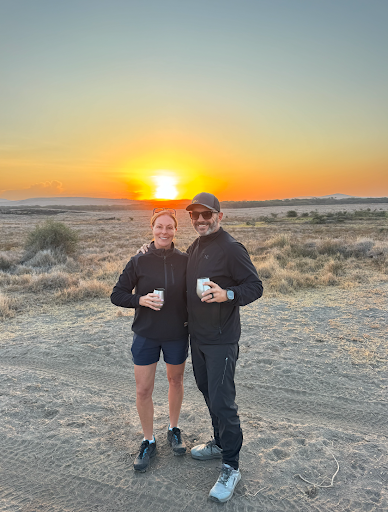
Subscribe to Full Spectrum Newsletter
Get insights delivered to your inbox monthly.
Subscribe to Full Spectrum Newsletter
Get insights delivered to your inbox monthly.