Explore the Full Spectrum of Leadership and Life Mastery
Issue #136 Breakfast, Tears, and Two Words That Saved My Relationship With My Daughter
Brad Pedersen
June 30, 2026
•
10 min read
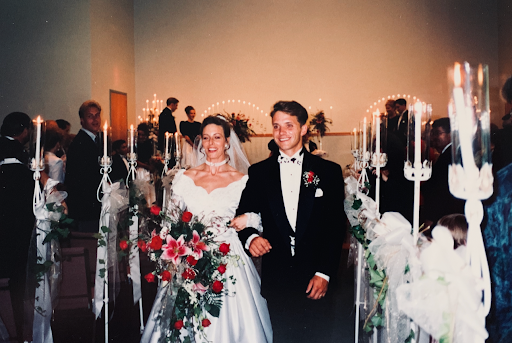
The picture for this newsletter is from this past week where Meg and I were in Verbier, Switzerland.
We joined a group called Strive, made up of thirty founders and leaders from around the world coming together for a week of adventure including: hiking, biking, and my first ever paragliding flight. Alongside the adventure was the harder work, growing ourselves through honest, intentional conversation with people we'd just met.
Then I was met with an unexpected surprise. On the last night before dinner, one of the group leaders asked Meg to share what she was taking from the weekend.
She started by talking about the people in the room; how impressed she was with the conversations, the character and the way everyone had shown up open and curious with each other.
Then her voice started to tremble as she turned while looking at me, saying something that caught me off guard….she apologized.
She admitted that she had carried resentment toward me for much of her childhood. From her perspective, the business often felt like it was competing with our family for my attention, and too often it seemed to win.
But with the benefit of time and perspective, she said she could now see something she hadn’t been able to see before.
She could see that behind the long hours and relentless effort was a father who was trying, imperfectly, to create freedom and opportunity for the people he loved. She acknowledged that many of the experiences we now shared, including that very trip to Switzerland, had been made possible by investments and sacrifices that had occurred years earlier.
And then, through tears, she thanked me.
We found ourselves in a spontaneous embrace in front of the whole room.
As we hugged I whispered into her ear: “I love you so much and I am so incredibly proud of you.”
I will never forget that truly precious moment and even as I write these words my heart is filled with joy and I have a deep sense of gratitude.
I share that not to brag about my daughter, but rather to inspire hope; the truth is, only a few years earlier, that moment would not have been possible.
Where It Actually Started
I was raised in a stoic home, where emotion was not something we expressed openly. My father held himself, and everyone around him, to a very high standard. He led by example, constantly pursuing excellence, always pushing to become a better version of himself.
Without ever consciously deciding to, I did the same. I held myself to that same high bar, and I unknowingly held the people closest to me to it as well. In many ways, it made me unrelatable.
Reflecting back now, I can see that the standard I set didn't build relational bridges, but rather it created barriers, especially in my most important relationships.
One day, when Meg was in her late teens, we were locked in a heated discussion, and I fell back on a familiar pattern of mine: trying to "solve" the issue with advice pulled from a book, a quote or an audio program I'd half memorized.
My intention was to help, but unknowingly I was actually hurting and my low self awareness was resulting in a delivery that was badly missing the mark.
She burst into tears and said, "This is just another example where I will never be good enough for you," and stormed out of the room.
I was stunned. Her words hit like a freight train, exposing cracks in our relationship I hadn't been willing to let myself see. My first reaction was defensive, even self righteous; but I couldn't shake the pain in her voice.
Somewhere in the quiet of that evening, a harder thought found its way into my mind.
If I continued down the path I was on, I was going to lose my daughter; not in the physical sense, but in a way that felt far more painful. I was losing her emotionally.
The relationship I had with my children was one of the deepest joys in my life. Yet, in my pursuit of success, achievement, and everything I thought mattered, I had become blind to what was happening right in front of me. Without intending to, I was creating distance where I wanted connection.
For the first time, I could clearly see the destination of the road I was traveling. It led straight to regret.
What made the realization so unsettling was knowing that no one was coming to change the outcome for me. The responsibility sat squarely on my shoulders. If the trajectory of our relationship was going to change, I would have to be the one to change it.
The next morning I knocked on her door and asked if we could go to breakfast.
Sitting across from her at the restaurant, I started with two of the most powerful words in the English language.
"I'm sorry."
I told her I had been parenting the way I had been parented. That I didn't have it figured out, and that I knew that I had been making mistakes. I told her this was my first time being a father to a teenage girl, and that in that role, I was still learning. I asked for some grace while I found my way.
Then I did something I hadn't done before: instead of giving her advice, I started asking her questions. Instead of trying to be interesting I chose to be interested. For the first time that I could remember, I chose to be curious about her, and then asked her how I could show up differently and to be a better father.
Tears flowed freely, even as we sat in the middle of a busy restaurant. I am certain the tables around us were wondering what was going on and if we needed some kind of intervention.
That breakfast was the first time I can remember crying in front of my daughter. I have since come to believe that tears are often the best way for the heart to speak. However with my stoic upbringing, I had to give myself permission to be able to express myself that way.
That breakfast became the first meaningful conversation I could remember having with Meg and it was a turning point, not just for our relationship, but for how I would decide to show up as a father into the future.
What I Didn't Understand Yet
Looking back now, I can see that the problem was never the advice itself.
The real issue was that I was trying to parent from a place of certainty rather than authenticity. I felt an unspoken pressure to have the answers, to project confidence, and to model what I believed a good father was supposed to look like. In doing so, I was holding my children to standards that often reflected the expectations I placed on myself.
What I failed to recognize was that my effort to appear strong and capable was making me less relatable.
Even more concerning, I had begun relying on learned methods to manipulate outcomes. I had read the books, listened to the experts, and I had accumulated a toolbox full of techniques. While many of them were helpful, I was using these tools to manage behavior rather than deepen connection.
Children have an uncanny ability to detect what is genuine. They may not always be able to articulate it, but they can sense the difference between someone who is genuine and someone who is trying to engineer an outcome.
What I was slowly learning is that relationships can sometimes be initiated through techniques, persuasion, or even subtle manipulation, but they can never be sustained that way. The deeper the relationship, the more it depends on a single foundation: trust.
And trust is not built by appearing to have all the right answers.
It grows when people experience the real you. When there is harmony between what you think, what you say, and how you show up. When your words and actions tell the same story.
I had it backwards.
I thought the work was external. I thought I needed to fix her, fix the conversation, or try to fix the outcome. What I eventually realized was that the real work was internal.
The quality of our relationships is limited by the quality of the person we bring into them.
You cannot consistently give away what you do not possess. Humility, patience, empathy, curiosity, and grace are not techniques to be deployed when needed. They are character qualities that must first be cultivated within us.
They are not skills we borrow from a book; they must become part of who we are.
Which means the deeper work is not simply learning better relational strategies. The deeper work is becoming the kind of person from whom those qualities naturally flow.
Like a tree, our lives will only bear healthy fruit when they are supported by healthy roots. If we want more patience, deeper empathy, and stronger relationships, we cannot focus on the fruit, until we first tend to the roots.
It is roots before fruits!
The Account Nobody Tells You About
We all understand how a bank account works. You make deposits, you build a reserve, and that reserve is what allows you to make a withdrawal later without going into the red.
Our closest relationships run on the same principle. Stephen Covey referred to it as our emotional bank account, and the currency that gets deposited, the thing that actually accumulates, is trust.
Every act of kindness, every kept promise, every honest word is a deposit of trust. Every act of disrespect, every broken commitment, every dismissive comment is a withdrawal against it.
When that account is full, communication is natural and authentic, and forgiveness can be freely offered even when mistakes are made.
However repeated shortcomings that go unnoticed or un-apologized, will cause our emotional bank account to run low and the smallest thing becomes a trigger. This is when couples stop talking openly and start managing each other. Parents and teenagers stop having conversations and start having negotiations. People start walking on eggshells, protecting themselves instead of investing into a deeper relationship.
The hardest part is this: deposits are slow and gradual, but withdrawals can be sudden and devastating. It takes years to build trust and only seconds to destroy it.
My account with Meg had been slowly drained over the years, not through any single dramatic moment, but through a steady pattern of correcting more than connecting.
Our tearful breakfast did not magically repair the relationship, but it did stop the damage.
For the first time in a long time, I stopped making withdrawals and started making a deposit.
Trust is built slowly, one interaction at a time. That morning marked the beginning of rebuilding a reserve that would grow steadily over the years. It helped create the foundation that allowed for our time together in Verbier.
There are six specific ways to build that reserve of trust (which I will unpack in next week’s newsletter), but underneath all of them lies one foundational principle: We must seek first to understand before seeking to be understood.
It sounds simple, but it is remarkably difficult in practice, especially for high achievers who are hell-bent on fixing things and who are accustomed to giving direction and offering answers.
For years, I sat across the breakfast table focused on what I wanted to say. That morning, for perhaps the first time, I became genuinely curious about what she had to say.
I did it imperfectly and I stumbled through it but it was a start. And with every conversation that followed, I got a little better at listening before speaking, understanding before advising, and connecting before correcting.
What I Want to Leave You With
After Meg finished speaking that evening in Verbier, several people approached me. They spoke about hope. Hope for their own children, hope for strained relationships and hope that things could still be repaired.
I was grateful for their kind words, but as I listened, I found myself reflecting on a different part of the story.
What they witnessed that night was not the result of getting parenting right. It was the result of getting it wrong, recognizing it, and choosing to change.
Years earlier, if I had continued down the path I was on, that moment in Verbier would have never happened. The speech, the laughter, the affection, the ease between us; all of it was built on thousands of small choices that came long before we ever came together for that tearful embrace.
What people saw was the fruit.
What they did not see were the years of tending the roots.
The difficult conversations. The apologies. The moments of vulnerability. The decision to listen more and lecture less. The countless deposits made into an account that had once been dangerously close to empty.
None of it was glamorous. None of it happened quickly. And there was no guarantee along the way that it would lead to the outcome I hoped for.
But over time, trust grew.
C.S. Lewis once wrote, “You can’t go back and change the beginning, but you can start where you are and change the ending.”
I find great comfort in that thought.
Because wherever you find yourself today, in whatever relationship matters most to you, the opportunity to make a different choice still exists.
You do not need a perfect plan.
You do not need to have all the answers.
You simply need to make the next deposit.
And sometimes the first deposit is only two words:
I’m sorry.
So this week ask yourself:
Where in your life are withdrawals quietly outpacing deposits, and what would it cost you to keep ignoring it?
Is there a relationship where you have been trying to fix or correct someone instead of trying to understand them?
What is one deposit, however small, you could make today in the account that matters most to you?
New here?
Discover Where You're Thriving and Ready to Grow


Subscribe to Full Spectrum Newsletter
Get insights delivered to your inbox monthly.
Subscribe to Full Spectrum Newsletter
Get insights delivered to your inbox monthly.